

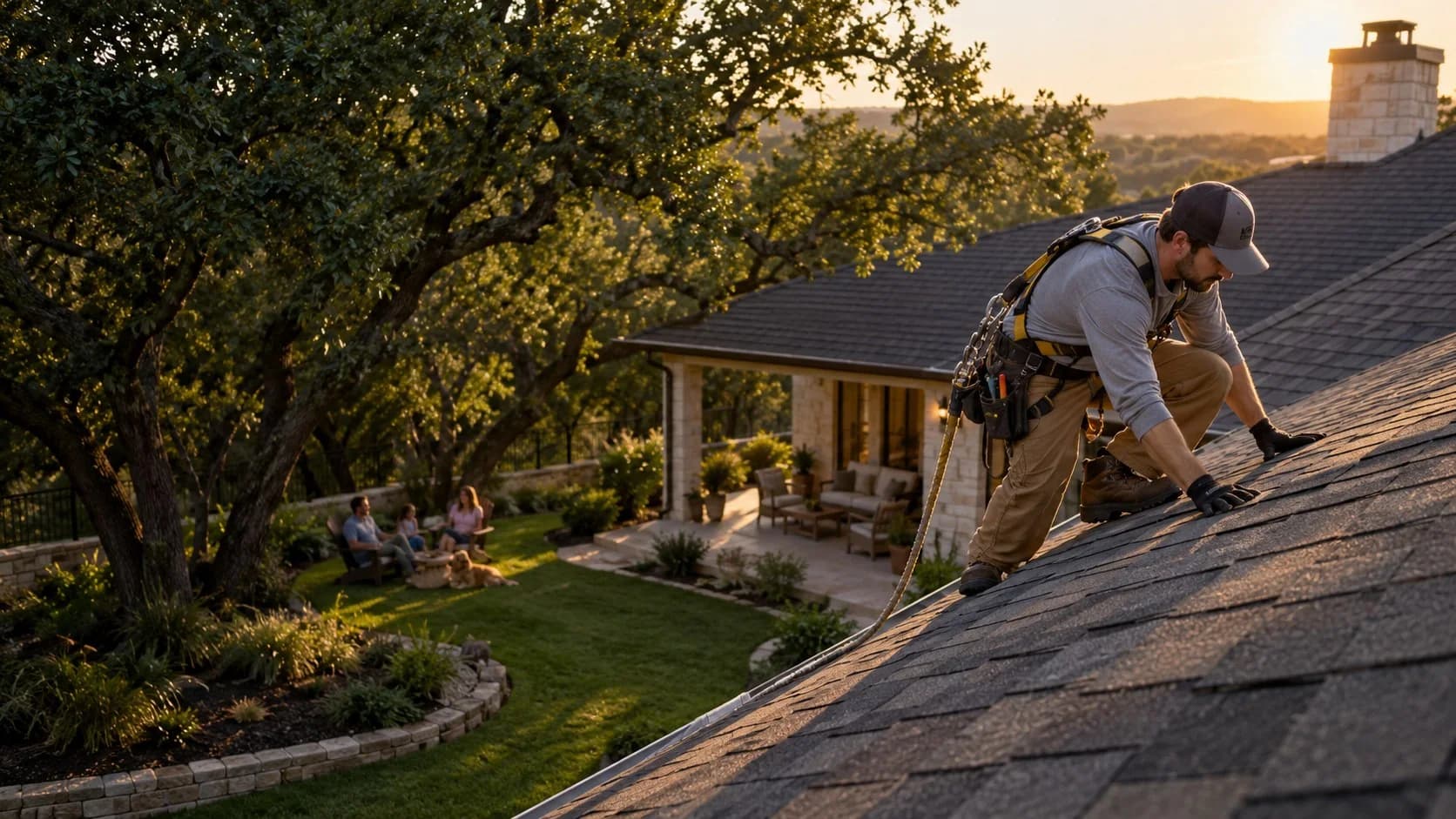
Tie Roof Images to Estimates — Make AI Flags Review Prompts
When images feed an estimate, they must remain traceable, verifiable, and safety-aware. Treat AI detections as prompts for human review—not final decisions—and set clear retention and sign-off controls before you rely on visual evidence in bids.
Why traceability matters
Roofing teams increasingly use drones, thermal sensors and image-powered estimating tools to speed inspections and create takeoffs. As one practitioner put it: "A drone roof inspection is a method of assessing a roof’s condition by using a drone equipped with high-resolution cameras and sensors." .
That data becomes part of project records, and you must manage it as you would any other contractual evidence: consistent metadata, a chain of custody, and a human sign-off. As an industry commentator warned, "AI alerts, risk scores and predictive assessments become part of your company’s digital footprint." .
Practical consequence: an image file without timestamp, GPS, operator ID and link to the estimate is weak evidence. You want every photo to resolve to the estimate line-item it supports and a named reviewer who accepted or rejected the AI flag.
Use AI as a review prompt, not a decision-maker
AI and computer vision speed detection of likely damage or hazards, but they are tools for triage. "These systems do not replace the role of a competent person; they extend that person’s reach," — translate that into policy: every AI flag opens a required human review step that records acceptance, adjustment, or rejection.
Operationally, implement an "AI flag = review" workflow: an automated alert attaches the source images, the model’s confidence score, and why it flagged the area. The field supervisor or estimator then annotates whether the AI result is accepted and links the acceptance to the estimate item.
From a legal and risk perspective, keep in mind adoption constraints such as regulation and environmental limits: "Adoption is constrained by aviation compliance requirements and weather-related operational limitations across roof inspection projects." .
Limits of images and site safety review
Imagery is powerful but incomplete. "A drone cannot replace every hands-on roofing assessment, but it can give a clear aerial view without putting a person on a steep, fragile, or storm-damaged surface." . Use aerial data to reduce exposure hours, not to substitute every physical check.
Image-based systems struggle with low light, thermal timing, complex geometry and occlusions. Build explicit checks: thermal scans during appropriate temperature transitions, RTK-positioned photos for precise measurements, and a mandatory in-person safety assessment if structure or access looks compromised.
Capture site-safety outcomes as part of the evidence chain: did the drone remove the need for roof access? If not, document why a hands-on evaluation was required and who performed it.
A bounded pilot you can approve
Run a 60–90 day pilot that pairs drone/thermal captures with your estimating workflow on a controlled set of jobs (residential and small-commercial). For each inspection require: pre-flight plan, metadata capture (timestamp, coordinates, operator ID, platform), automated AI flagging, and human review recorded in the estimating system.
Decisions supervisors must approve: whether an AI-flaged defect becomes an estimate line item; whether a site requires in-person safety inspection; and the retention period for raw imagery and AI outputs. Make those approvals explicit in the sign-off screen.
This is a hypothesis-driven trial: you’ll validate whether traceable images reduce rework, speed estimate acceptance, and preserve safety. The pilot must include vendor and privacy reviews, Part 107 operator checks, and documented data-retention policies.
Measure the outcome.
Establish your own baseline. These are measures to test, not promised results.
A different seat.
A different question.
For owners
You must approve the pilot scope, insist on metadata capture for every image, and set retention and legal review policies so evidence strengthens contracts rather than creates new risk.
For chief executives
Approve resources for a bounded pilot that links field imagery to revenue decisions and requires executive review of data governance and vendor contractual terms.
For operations
Implement the operational chain: trained Part 107 pilots, standardized preflight plans, mandatory human review of AI flags, and clear safe-access triggers for hands-on inspections.
For finance
Require metrics tied to decision speed and dispute reduction, enforce retention policies to limit liability exposure, and approve budget conditioned on measurable evidence improvements.
For technology leaders
Deliver metadata capture, secure storage, and an auditable sign-off UI that writes image provenance, AI scores and reviewer decisions into the estimating system.
Sources & context
- Adopting AI by Bill Arseneau, MBA 2025-05-01 | Professional Roofing
- AI meets the job site by Adrianne Anglin, CSP 2026-07-01 | Professional Roofing
- Drone Roof Inspection Market, Global Market Analysis Report - 2036
- Best Drones for Roof Inspection in 2026
- Drone Roof Inspections: A Comprehensive Guide for Drone Pilots
AI-assisted editorial, reviewed against the linked sources. Illustrative industry imagery; it does not depict a named company’s staff or property. Research checked 2026-10-30.
One useful perspective.
Each week.
Choose your seat at the table.